
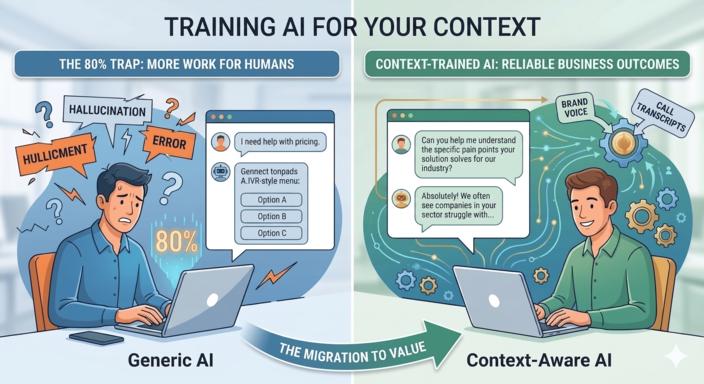
You’ve heard the headlines. Companies saving millions with AI. Entire departments becoming leaner, faster, smarter. So you tried it. You handed your team a chatbot, maybe a writing assistant, maybe an AI sales tool — and then… nothing really changed. Or worse, things got harder.
You’re not alone. And you’re not doing it wrong.
Here’s the real problem: most AI tools are trained on the internet, not on your business.
The 80% Problem
Most off-the-shelf AI gets you about 80% of the way there. The responses sound good. Sometimes they’re great. But that remaining 20%? It’s wrong. And here’s the cruel twist — an answer that’s almost right is more dangerous than one that’s clearly wrong.
When the AI confidently says something incorrect, your team has to catch it, correct it, and clean up after it. Instead of saving time, they’re spending more of it. That’s why so many business owners feel like AI is adding work, not removing it.
The tool isn’t broken. It just doesn’t know you.
A Generic Brain Doing Your Specialist Job
Imagine hiring a new employee who has read every book ever written — but has never worked in your industry, never spoken to your customers, and has no idea how your team operates. You wouldn’t hand that person your most important client calls on day one.
That’s exactly what most businesses do with AI.
AI models are incredibly capable. But capability without context is just noise. To be genuinely useful, AI needs to understand:
• Your industry — the nuances, the language, the way things actually work
• Your customers — how they speak, what they care about, what their problems really are
• Your processes — not just what you do, but how and why you do it
• Your voice — so every response sounds like you, not like a robot trying to sound like you
What It Looks Like When You Get It Right
Here’s a real example. One of our clients wanted their website chatbot to actually qualify leads — not just answer FAQs, but have real conversations, uncover pain points, and book calls.
The traditional chatbot approach? Build a decision tree. Force visitors to click through pre-set categories. Hope their problem fits one of your boxes. (It usually doesn’t.)
Instead, we trained the AI on:
• Their brand tone and voice — so it felt like talking to their team, not a script
• Hundreds of real call transcripts — so it understood how their customers actually speak and how ‘they’ respond
• Tagged context from those transcripts — so it could pick up on nuance, not just keywords
The result was a chatbot that holds real conversations. Visitors stopped typing “human agent” to escape it. Leads arrive on sales calls already pre-qualified, with their pain points surfaced and understood.
That’s the difference between AI that’s bolted on — and AI that’s built in.
So What Should You Actually Do?
Before you add another AI tool to your stack, ask yourself: does this thing know anything about my business?
If the answer is no — or “kind of, based on our website” — then you’re not getting real value yet. You’re getting a capable stranger guessing at your business.
The businesses winning with AI aren’t necessarily using fancier tools. They’re using AI that understands their context, their customers, and their voice.
That’s the gap. And it’s very fixable.
Want to explore what AI that actually knows your business could look like? Let’s talk.